
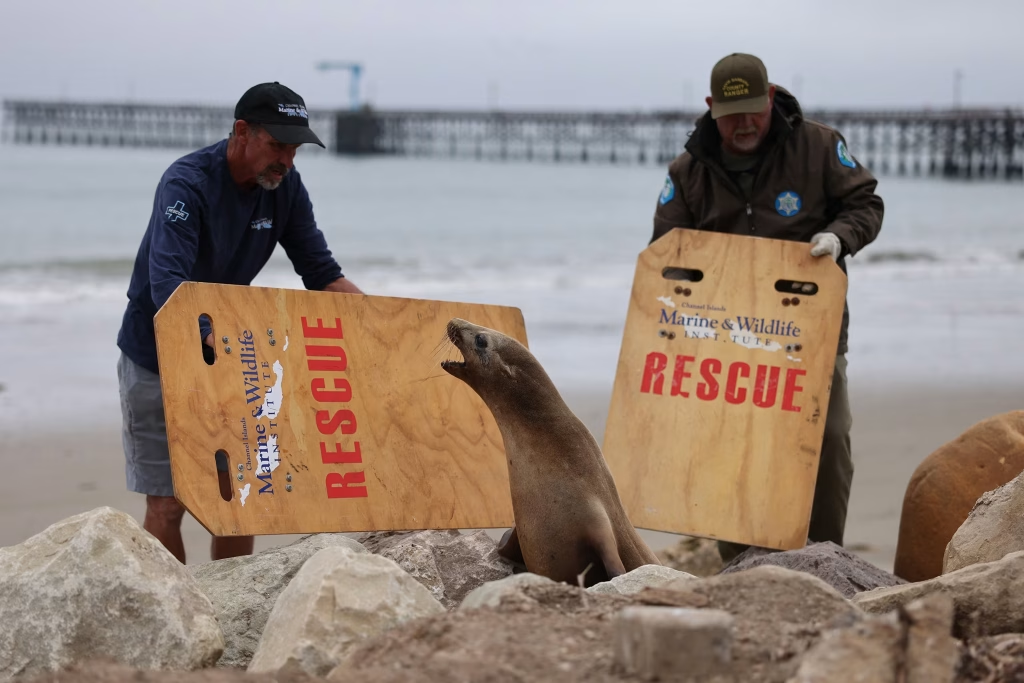
Across many miles along the Southern California coastlines, many beachgoers have been recently assaulted by sea lions. Those who have been attacked by these marine mammals have claimed that these approaching animals were “out of control”, maybe even “possessed” in the perspective of these beachgoers.
On March 30th, in Long Beach, during 15 year old Pheobe Beltran’s junior lifeguard tryouts, she was attacked by a sea lion. Beltran had many bite marks, bruises covering parts of her right arm. “I was just so scared, so shocked, still felt the immense pain on my arms, like, over and over again,” she told CNN.
Another victim, RJ LaMendola, a surfer who also was attacked by a sea lion, told BBC that the animal bit and dragged him off of his board. LaMendola has described his encounter with this marine mammal as “feral, almost demonic.”
The cause for these marine mammals aggressive behavior is from domoic acid poisoning, a type of microscopic algae called Pseudo-nitzschia australis, which produces domoic acid, a neurotoxin that can cause illness and even death.

The National Oceanic and Atmospheric Administration (NOAA) has stated that these microscopic algae, “grow out of control and produce toxic or harmful effects on people, fish, shellfish, marine mammals and birds.” The production of these toxins are called harmful algal blooms. Some of these blooms have a distinct red color but can also be completely invisible.
These algal blooms have happened in the past, such as the Monterey Bay in 1961, San Francisco during 1927, and more further at Florida’s coast in 1844, with even evidence of these algal blooms in fossils.
According to the U.S. National Office for Harmful Algal Blooms, “Geologic records from the Gulf Coast of Florida indicate several mortality events of cormorants, fish, and other birds in the late Pliocene. These remains were found with depositions of dinoflagellate cysts, indicating that these die-offs were caused by toxic blooms.”

The way domoic acid gets to these animals is from eating fish or shellfish who had already eaten the toxic algae. For example sea lions, dolphins and other bigger marine mammals.
According to the Marine Mammal Care Center, “Sea lions that are sickened by domoic acid often wash ashore weak, lethargic and disoriented. They also suffer from violent seizures that cause their heads to weave, or move side-to-side uncontrollably.” Unfortunately there is no known cure for domoic acid but these mammals can recover with permanent chronic neurological issues.
These violent seizures are most likely the cause for the recent attacks and aggressive behavior received by any beachgoers attacked by these specific mammals.
The CEO of the Marine Mammal Care Center in Los Angeles, John Warner has stated that there have been over 2,000 calls about sea lions with domoic acid poisoning to their hotline. Domoic acid is considered a death sentence to some marine mammals such as dolphins.
“There’s no rehabilitation that’s going to work with dolphins. Most of the time when they strand, they’re already deceased. The ones that are struggling on the beaches that are seizing,” Warner told CNN Climate.
The Marine Mammal Center, Marine Mammal Care Center Los Angeles, National Institute of Environmental Health Sciences, and U.S. National Office for Harmful Algal Blooms are some organizations who are actively researching domoic acid poisoning in fresh and salt bodies of water.
Professionals and marine mammal care centers have advised beachgoers to stay 50 feet away from marine mammals that seem lethargic or are resting on beaches. Despite their unpredictable behavior caused by this illness, they are still the charismatic and happy going sea lions as before.
Written by Andrew Gomez, Staff Writer